If you’ve been reading my previous posts, you’ve probably noticed that I love uncovering the hidden secrets behind how devices are built. I guess it’s the spirit of Indiana Jones, but dressed in electronics and reverse engineering. The knowledge gained this way pairs perfectly with practical repairs - I often end up partially (or sometimes completely) reversing schematics of all kinds of electronic devices at my workshop. Over time, you develop a pretty good eye for distinguishing brilliant design choices from stuff that was clearly thrown together on a Friday afternoon.
Today I want to show you a real gem I stumbled upon just a few days ago while analyzing one particular board.
Standard way of driving MOSFETs
Driving a power MOSFET involves two key challenges:
-
providing a high enough gate-source voltage $%U_{GS}$% so the transistor fully turns on instead of lingering in a half-on state. With logic-level MOSFETs it’s usually not an issue, but with beefier parts you suddenly need to find ~10 V from somewhere.
-
delivering a decent amount of charge to the gate as quickly as possible. The time when the MOSFET is already conducting current but hasn’t yet reached its minimum $%R_{DS(on)}$% is exactly when it heats up the most.
Normally, when connecting 3.3 V TTL logic to a power MOSFET, we just throw in a dedicated gate driver IC and call it a day. Simple and effective, no finesse.
The gem: using comparators as MOSFET drivers
The solution I’ve been looking at has been working flawlessly in products for years. In this case, the MOSFETs are used to drive brushed DC motors. What makes it special? The designer drove the MOSFET gates directly with CMOS comparators while the rest of the board runs on 3.3 V TTL logic. Here’s the circuit I reversed:
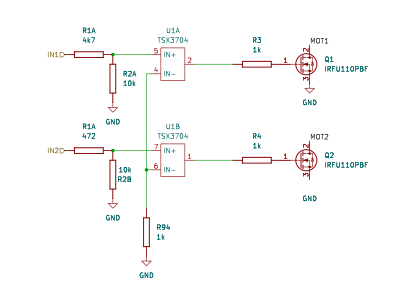
Driving power MOSFETs from 3.3 V logic using CMOS comparators – RE circuit
When this approach is brilliant (and when you should stay away)
The beauty of this solution lies in its simplicity and clever thinking. And yes - it actually works reliably in the real world. But does that mean you can just replace dedicated MOSFET drivers with comparators everywhere? Not quite.
Switching speed - the main limitation
The critical moment is when the MOSFET transitions from off to fully on. During that short period, current is already flowing while the channel resistance is still high, so power dissipation spikes:
$$ P=R_{DS} \times I_D$$
The longer this transition takes, the more heat you generate. Even a relatively fast comparator like the TSX3704 (response time ~2.7 µs) can’t push nearly as much current as a proper gate driver. This approach works great when:
- you’re using on/off control or low-frequency PWM (up to about 1–2 kHz)- in other words for
- driving brushed DC motors, pumps, fans, or other low-side loads
It falls apart with higher PWM frequencies (several kHz or more), big MOSFETs with high gate charge (Qg), or high continuous currents. The MOSFET spends too much time in the linear region and will thermally collapse.
Temperature and protection
Dedicated gate drivers usually include UVLO (Undervoltage Lockout) and thermal protection. The comparator solution doesn’t have any of that. If the supply voltage drops or things get too hot, behavior can become unpredictable with a spectacular ending. Fine for cheap consumer gear running at room temperature, but less ideal for equipment that needs to run reliably for years or in warmer environments.
H-bridge applications
This is where things get tricky - and dangerous. In an H-bridge you need to switch the circuit in a diagonal pattern. Any overlap where both high-side and low-side transistors connected in series conduct at the same time means a direct short across the power rail (shoot-through). Because comparators switch slower and don’t provide built-in dead time, you have to be extremely careful with timing. If you’re planning an H-bridge, you’re much better off using a proper driver with dead-time control or a dedicated H-bridge IC.
Cost advantage
Here’s where this solution really shines. Driving four low-side N-channel MOSFETs with a single TSX3704 quad comparator plus a handful of resistors is dramatically cheaper than using four separate gate drivers. Perfect for mass-produced, cost-sensitive devices.
Aftermath
Doing reverse engineering gives you a lot of satisfaction when you discover little hardware gems like this one: a cheap, effective way to drive MOSFETs that is simply brilliant. Respect to the designer who didn’t just copy-paste the typical application note of a dedicated IC, but actually understood the principles and came up with a simpler, cheaper, and still reliable solution. I hope this encourages you to dive into RE and hunt for your own pearls. What do you think about this approach? Do you have any boards in your drawer where comparators are driving MOSFETs? Drop a comment and let me know!